Drop an image hereor click to chooseJPG, PNG, WebP
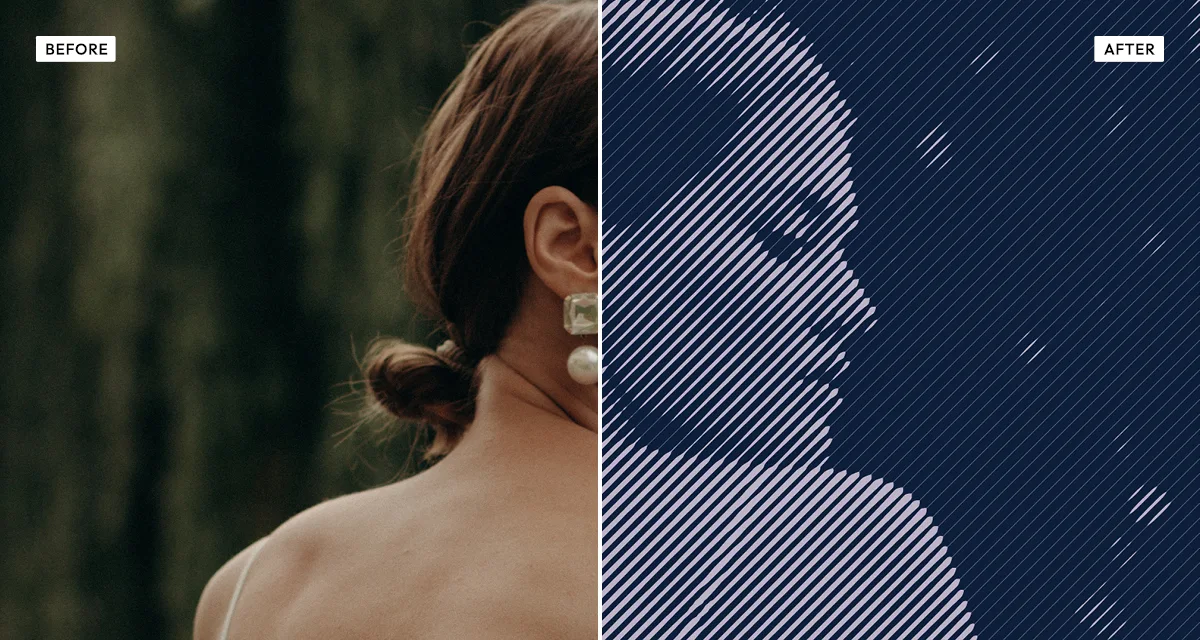
About the Engrave Halftone Effect
Last updated 21 August 2026
How the effect works
Before halftone dots, printed images were engraved by hand. An engraver cut lines into a steel or copper plate, and tone came from how closely those lines were spaced and how thick they were cut — dense heavy lines for shadows, fine widely spaced ones for highlights. Cross-hatching, where a second set of lines crosses the first at an angle, extended the range further.
The technique survived long past the point where photography made it unnecessary, for one reason: it is very hard to forge. Reproducing an engraved line pattern requires the original plate, which is why banknotes, bonds and share certificates still use it, and why it reads as authoritative and old-money rather than merely old.
Here density sets how closely the lines are ruled and angle rotates the whole pattern. Raising contrast first matters more than with dot halftone, because line engraving has an even shorter tonal range — the lines either merge into solid black or separate into white, with less middle ground than dots provide.
What each control does
| Control | Range | Default | What it changes |
|---|---|---|---|
| Angle | 0–180° | 45 | Rotation of the line pattern. 45° is the engraving convention and least visually intrusive. |
| Density | 3–40 | 8 | How closely the lines are ruled. Low is coarse and graphic; high is fine and banknote-like. |
| Contrast | −50 to +100 | 45 | Raised by default: line engraving has a shorter tonal range than dot halftone. |
| Brightness | −100 to +100 | 0 | Shifts where lines merge to solid and where they drop out entirely. |
| Colours | ink and paper | — | Line colour and background colour, for ink-on-cream or any other pairing. |
Tips
- Keep angle near 45°. It is the engraving convention because diagonal lines are the least visually intrusive to the eye.
- Raise contrast further than you would for dot halftone. Lines have a shorter tonal range and a flat source turns to solid black.
- Portraits and single objects engrave well. Busy scenes lose their structure, because lines cannot describe two overlapping textures at once.
- Try ink on a cream paper colour rather than pure white — it is what the technique actually looked like in print, and it softens the contrast.
Common uses
Editorial portraits, book and album covers, certificates and awards, packaging for spirits and heritage brands, logos and crests, financial and legal design, and any piece that should read as engraved rather than printed.
Frequently asked questions
What is the engrave halftone effect?
The engrave halftone effect rebuilds a photograph from ruled lines rather than dots, varying line weight and spacing with tone. It reproduces steel engraving, the technique used for banknotes, share certificates and newspaper hedcut portraits.
How do I turn a photo into line art?
Rebuild it from ruled lines whose weight and spacing vary with tone, rather than from dots. Density sets how closely the lines are ruled — low is coarse and graphic, high is fine and banknote-like. Raise contrast further than you would for dots, because lines have a shorter tonal range.
How do I make a photo look like a banknote or certificate?
Use fine line density at a 45-degree angle, ink on a cream paper colour rather than pure white. That is what steel engraving actually looked like in print, and it is still used on banknotes and share certificates because the line pattern is very hard to forge or photocopy convincingly.
Is the engrave halftone effect free to use?
Yes. The engrave halftone effect is free, and you can adjust every setting and preview the result without signing up. Credits are only needed to download at full original resolution; the preview and standard-resolution download cost nothing.
Do I need to upload my photo?
No. The engrave halftone effect runs entirely in your browser, so your original photo is processed on your own device and never leaves it. If you are signed in and save a full-resolution download, the rendered result — not your original — is stored in your private account folder, encrypted with AES-256, and deleted automatically after 30 days.
Why are banknotes and certificates printed with engraved lines?
Because engraving is hard to forge. Tone comes from lines cut into a steel plate at precise spacing and depth, and reproducing that pattern convincingly requires the original plate. Photocopiers and scanners render the fine lines poorly, which is why the technique outlived the printing constraints that created it.
What is the difference between engrave halftone and duo halftone?
Engrave halftone uses ruled lines, reproducing steel engraving. Duo Halftone uses dots in two ink colours, reproducing offset and screen printing. Lines read as formal and authoritative; dots read as printed and commercial.
Can I use the engrave halftone effect on client or commercial work?
Yes. Images you create with the engrave halftone effect can be used for personal and commercial projects, including client work, packaging and merchandise. Full terms are on the licence page.
Related effects
For dot halftone in two inks, see Duo Halftone. Old Newspaper applies a coarse newsprint screen, Dramatic Black and White gives tonal monochrome instead, and Risograin prints in a single risograph ink.